
Power Correction Factors and Derating Strategies for Gear Reducers in High-Altitude Environments:
A Complete Selection Guide
In high-altitude regions—such as the Qinghai-Tibet Plateau in China, the Andes in South America, or the Rocky Mountains in North America—environmental factors like thin air, low atmospheric pressure, and drastic diurnal temperature swings pose severe challenges to the operational performance of gear reducers and their matching motors. Many engineers who directly transfer equipment successfully used in lowland plains to fields at elevations of two to three thousand meters quickly encounter issues. These include gear reducer overheating, frequent motor overload trips, oil seal leakage, and early gear failure. The root cause is a failure to properly understand the derating impact of high altitudes on the power output and thermal dissipation capacity of gear reducers.
What exactly is the power correction factor for gear reducers in high-altitude environments? How do you accurately calculate the correction value based on altitude? This article provides a comprehensive selection guide and response strategy based on international standards, reference correction factors from mainstream brands, and the combined effects of high altitude on gear reducer lubrication, sealing, and insulation.
1. Why High Altitude Requires Sizing Correction for Gear Reducers
Before discussing specific correction factors, we must clarify a fundamental concept: a gear reducer itself, as a purely mechanical transmission component, does not see its mechanical efficiency or load-bearing capacity significantly alter with altitude in theory. What is severely affected by high altitude is the driving motor paired with the gear reducer, as well as the thermal power of the gear reducer—meaning the maximum power it can continuously transmit without causing overheating.
When the altitude exceeds 1000 meters, the decrease in air density leads to two direct consequences. First, the cooling capacity of the motor drops because the volume of air blown by the fan decreases, reducing heat dissipation efficiency. Second, the dielectric strength of the air weakens, making high-voltage motors particularly susceptible to corona discharge. Therefore, the International Electrotechnical Commission standard IEC 60034-1 and Chinese National Standard GB/T 755 explicitly stipulate that the design baseline condition for motors is an altitude not exceeding 1000 meters and an ambient temperature not exceeding 40°C. When the altitude exceeds this range, the rated output power of the motor must be corrected, which means it must be derated for use.
For the gear reducer, high altitude indirectly impacts reliability by affecting lubricant performance and seal conditions. Rising oil temperatures lead to decreased lubricant viscosity and insufficient oil film strength. Meanwhile, the pressure differential formed between the low external atmospheric pressure and the internal thermal expansion accelerates oil seal leakage. Therefore, selecting a gear reducer for high-altitude environments is by no means as simple as applying a single power correction factor; it is a systematic engineering challenge involving heat dissipation, lubrication, sealing, and insulation.
2. Reference Values for Power Correction Factors from Mainstream Brands
Different manufacturers of gear reducers and motors provide their own recommended correction factors based on product design characteristics and extensive field data from high-altitude sites. Below are reference values from several common brands in the industrial sector. Sizing should always be based on the manufacturer’s latest manuals and selection software.
NORD — Explicit Derating Factor Tables
German brand NORD Drivesystems provides clear motor power derating factors in its technical manuals. This factor directly reflects the ratio of the allowable output power of the motor at different altitudes relative to its rated value at sea level. The specific values are as follows:
• Altitude of 1000 meters and below: Derating factor is 1.00, no correction needed.
• Altitude of 1500 meters: Derating factor is 0.97.
• Altitude of 2000 meters: Derating factor is 0.94.
• Altitude of 2500 meters: Derating factor is 0.90.
• Altitude of 3000 meters: Derating factor is 0.86.
• Altitude of 3500 meters: Derating factor is 0.83.
• Altitude of 4000 meters: Derating factor is 0.80.
Application Example: A motor with a rated power of 15kW at sea level will have an actual available power of only 15 \times 0.83 \approx 12.45\text{kW} if it drives a gear reducer in a plateau environment at an altitude of 3500 meters. If the load requires a 15kW output, a motor with a higher power rating must be selected, such as an 18.5kW or 22kW model.
ABB and Siemens — Combined Correction Based on Temperature and Altitude
ABB and Siemens, as global motor giants, emphasize the combined effect of altitude and ambient temperature in their correction strategies.
• Siemens: When the altitude is between 2000 and 3000 meters and the ambient temperature does not exceed 30°C, certain motor models may not require derating according to the conversion method of the IEC standard. This is because the lower ambient temperature partially offsets the impact of reduced cooling capacity. However, if the ambient temperature remains at 40°C, derating is mandatory. Siemens recommends contacting technical support or using specialized selection tools for precise calculations when the altitude exceeds 2000 meters.
• ABB: ABB offers an intuitive power upscaling conversion method. For example, a 4kW motor at sea level requires its insulation class and temperature rise margin to be significantly upgraded to ensure reliable operation at an altitude of 4500 meters with an ambient temperature of 40°C. In practice, a 5.5kW motor must be selected. This means the power needs to be increased by approximately 27.5% to counteract the effects of high altitude.
SEW — Thermal Power Correction Following IEC Standards
As a leader in the gear reducer industry, SEW-EURODRIVE also strictly follows IEC 60034-1. In SEW selection manuals, special emphasis is placed on the derating parameter related to installation altitude, usually represented by the symbol f_{AH}. This factor directly acts on the allowable output torque of the motor. For example, when the altitude rises to 3000 meters, the allowable torque under thermal power limits may decrease by about 15% to 20%, depending on the gear reducer model and cooling method (built-in fan or forced cooling).
In addition, SEW specifically reminds users that if the gear reducer needs to start and stop frequently, run in forward and reverse, or operate under full load for a long time in a plateau environment, an extra safety margin of 0.05 to 0.10 should be added to the standard correction factor.
Domestic General Gear Reducers — Empirical Formulas
For many small and medium-sized enterprises using domestic general gear reducers without detailed correction data from the manufacturer, empirical formulas within the industry can be referenced. Within the altitude range of 1000 meters to 4000 meters, for every 1000-meter increase, the power correction factor can be taken as 0.90 to 0.87. That is:
• Altitude of 2000 meters: Factor is approximately 0.90
• Altitude of 3000 meters: Factor is approximately 0.87
• Altitude of 4000 meters: Factor is approximately 0.84
Alternatively, some references use a simplified method of a 15% power redundancy, meaning they select a model directly at 1.15 times the power required at sea level. However, this approach is rough and only suitable for low-precision, low-load situations.
In summary, at an altitude of 4000 meters, mainstream recommended power correction factors are concentrated between 0.80 and 0.85. Translated into selection practice, if you need a motor with an output power of 30kW to drive a gear reducer on a plateau at an altitude of 4000 meters, you should choose a motor with a rated power of at least 30 / 0.80 = 37.5\text{kW}, which means selecting a model close to the 37kW to 45kW rating class.
3. Three Core Impact Dimensions of High Altitude on Gear Reducers
Power correction is only the first step. High altitude also directly affects the reliability and lifespan of the gear reducer through three key dimensions.
3.1 Heat Dissipation and Temperature Rise — Significant Drop in Thermal Power
Gear reducers generate heat when transmitting power, and this heat must be dissipated into the environment through housing surface radiation, natural convection, or forced air cooling. The thin air at high altitudes causes a sharp decline in convection cooling capacity.
Specific Data: For every 1000-meter increase in altitude, air density drops by about 12%, the temperature rise of the motor increases by 3% to 10%, and the heat dissipation capacity drops by 8% to 12%. When the altitude reaches 3000 meters, the heat dissipation capacity of air-cooled systems typically drops by 40% to 50% compared to sea level. This explains why many air-cooled gear reducers feel much hotter to the touch on plateaus than at sea level.
Thermal Power Correction: If the gear reducer you choose relies on natural cooling (without an external fan), its allowable transmitted thermal power at high altitudes must be corrected using the following formula:
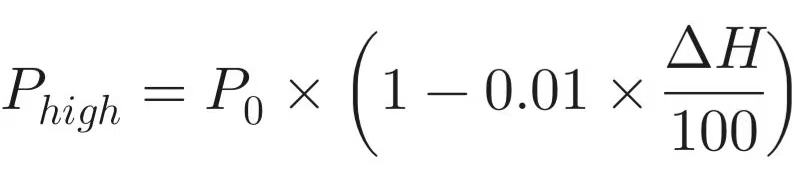
where \Delta H is the altitude increment exceeding 1000 meters. For example, at an altitude of 3000 meters, the thermal power is only about 80% of that at sea level. If the load power exceeds the thermal power, the gear reducer will continue to heat up until the lubricant ages and the gears scuff.
3.2 Lubrication and Sealing — The Dual Challenge of Oil and Seals
Lubricant Viscosity and Oil Film Strength: In high-altitude, low-pressure environments, the light components in lubricant oil volatilize more easily, changing the oil properties. More importantly, the viscosity increases sharply during low-temperature startups and drops precipitously during high-temperature operations, making the load-bearing capacity of the oil film unstable. For example, the kinematic viscosity of ISO VG220 industrial gear oil at 0°C may increase to about 380 mm^2/s (nearly 1.7 times the rated viscosity). This significantly increases the starting torque, making the motor prone to overloading. Conversely, under high temperatures and heavy loads, the viscosity may drop below 150 mm^2/s, causing accelerated gear surface wear due to insufficient oil film strength.
Seal Failure and Oil Leakage: This is one of the most common failures of high-altitude gear reducers. The reason lies in the large pressure differential between the inside and outside of the housing. Internal gear churning and heating cause the internal air pressure to rise, while the external atmospheric pressure is lower than at sea level. This pressure difference forces oil and gas to leak from any weak point. Common nitrile rubber (NBR) oil seals see their rebound performance drop by about 30% to 40% in low-pressure environments, meaning the seal lip cannot tightly fit the shaft journal. Statistics show that in mining equipment at altitudes above 3500 meters, the oil leakage failure rate of gear reducers increases by 5.8 times compared to plain regions.
3.3 Insulation and Start-Stop — Electrical Safety and Cold Start Problems
For gear reducer systems driven by motors, the impact of high altitude on motor insulation cannot be ignored. For every 1000-meter increase in altitude, the dielectric strength of air decreases by about 8% to 13%. For common low-voltage motors with a rated voltage of 380V or 690V, the impact remains within a controllable range. However, for high-voltage motors of 6kV or 10kV, corona discharge occurs very easily, accelerating insulation aging or even causing breakdown.
In addition, the diurnal temperature difference in plateau areas is extreme (potentially dropping from 20°C during the day to -15°C at night), making the lubricant extremely viscous at low temperatures. During the first startup in the morning, the motor needs to output a starting torque far greater than its usual rated torque. Field tests indicate that in a -10°C environment, the starting torque of ISO VG220 lubricant is 2.3 times that at room temperature (40°C). If this factor is not fully considered during selection, the motor is highly likely to trip due to overload at the moment of startup.
4. Comprehensive Responses and Selection Practices: Five Actionable Strategies
Knowing the causes and correction factors, how should we respond in actual selection and field operation and maintenance? The following five strategies have been verified by multiple high-altitude engineering projects and offer high operational feasibility.
Strategy 1: Directly Select Plateau-Type Specialized Motors
This is the most thorough and hassle-free solution. Plateau-type motors account for low atmospheric pressure and deteriorating heat dissipation during their design and testing phases. Their insulation class is usually upgraded to Class H (temperature resistance of 180°C), and they feature thicker wires and larger fans. A motor labeled as “suitable for an altitude of 4000 meters” can directly output its nameplate rated power on a plateau without requiring manual derating calculations. Major manufacturers provide plateau-type series products; you only need to specify the altitude and ambient temperature range in the contract.
Strategy 2: Upgrade Insulation Class and Increase Electrical Clearances
If purchasing a plateau-specific motor is not feasible, modifications can be made based on a standard sea-level motor. Specific practices include upgrading the insulation class from Class F (155°C) to Class H (180°C), increasing the thickness of the insulation varnish at the winding ends, and appropriately increasing the electrical clearance and creepage distance inside the terminal box (generally recommended to increase by 8% to 10% for every 1000 meters). For variable frequency drive (VFD) systems, an output reactor or dv/dt filter must be installed on the output side to suppress voltage spikes.
Strategy 3: Switch to Synthetic Lubricants and Improve Lubrication Management
This is the core measure for tackling high-altitude lubrication issues. Synthetic lubricants (such as industrial gear oils based on polyalphaolefin or synthetic hydrocarbons) have a much higher viscosity index than mineral oils. They maintain good fluidity at low temperatures, remain stable at high temperatures, and incur minimal volatilization loss. It is recommended to replace the originally used mineral-type industrial gear oil with a fully synthetic gear oil of the same viscosity grade.
Concurrently, shorten the oil change cycle. In plain areas, gear reducers are typically changed every 3000 to 5000 operating hours. In high-altitude environments, given accelerated oil oxidation and volatilization losses, it is recommended to shorten the oil change cycle to 2000 to 2500 hours, sampling the oil every six months to test its viscosity, water content, and acid value.
Strategy 4: Strengthen Sealing and Venting Systems
To address oil leakage problems, the most effective engineering methods include:
• Replacing with Fluororubber (FKM) Skeleton Oil Seals: Fluororubber retains excellent elasticity under low atmospheric pressure and wide temperature ranges. Its service life is 3 to 5 times that of nitrile rubber.
• Installing Large-Diameter Anti-Clogging Breathers: Install an oil-cup type breather with a diameter of no less than 6mm at the highest point of the gear reducer housing. This balances the internal and external pressure difference while preventing dust from entering. For severe dust environments like mines, a flexible hose can route the vent to a dust collection box away from the debris.
• Adding Oil Collection Grooves and Return Holes: Machine an oil collection groove and a guide hole on the inner side of the output shaft end cap, allowing any accidentally seeped oil to flow back into the housing instead of leaking out.
Strategy 5: Enhance Auxiliary Cooling or Reduce Load
If an existing gear reducer is already running on a plateau but experiences overheating, auxiliary cooling devices can be added:
• External Fan: Add a forced cooling fan (with a power of tens to hundreds of watts) outside the gear reducer housing to greatly increase the speed of air flowing across the cooling fins, compensating for the low air density.
• Water Cooling Coil: For equipment running under continuous full load, a water cooling coil can be installed at the bottom or side of the housing to introduce circulating cooling water, directly carrying away heat. This method is highly common in the drives of mining crushers and ball mills at altitudes above 4000 meters.
If cooling modifications cannot be implemented, the only method left is to reduce the actual load. For example, lower the output speed of the gear reducer or reduce the feed rate so that the transmitted power stays below the thermal power threshold.
5. Summary
Power correction for gear reducers in high-altitude environments is not a single numerical issue; it is a systematic project ranging from motor derating, lubrication upgrades, and seal reinforcement to auxiliary cooling. The core points are summarized as follows:
• Correction Factors: At an altitude of 2000 meters, the power factor is about 0.94 to 0.97; at 3000 meters, it is about 0.86 to 0.90; at 4000 meters, it is about 0.80 to 0.85. Specific values must be checked in the respective brand manuals.
• Motor Selection: Priority should be given to plateau-type specialized motors; otherwise, increase the power by one size based on the correction factor.
• Lubrication: Switch to fully synthetic gear oil and shorten the oil change cycle.
• Sealing: Use fluororubber oil seals and install large-diameter breathers.
• Heat Dissipation: When thermal power is insufficient, add forced fans or water cooling coils.
As a final reminder, if equipment needs to operate in extreme environments above 5000 meters (such as mines on the Qinghai-Tibet Plateau or South American Andean mining areas), the general correction factors mentioned above may no its longer apply. You must calculate requirements directly with the technical departments of the gear reducer and motor manufacturers, and consider using special materials like ceramic-coated shaft journals and low-temperature molybdenum-based grease. We hope this article helps you make more reliable selection decisions in high-altitude projects, preventing equipment failures caused by ignoring high-altitude impacts.
High-Altitude Gearbox Derating Factor, Plateau Motor Sizing Calculation, SEW Gearbox High-Altitude Selection, Gear Reducer High-Altitude Lubrication and Sealing, Gear Reducer Plateau Temperature Rise Correction, Plateau Environment Gear Reducer Oil Leakage Solutions, High-Altitude Gear Oil Selection, Gear Reducer Thermal Power High-Altitude Correction.
Advanced Engineering Solutions for High-Altitude Challenges
Expanding on your five strategies, real-world commissioning in regions like Tibet or the Andes requires addressing specific micro-phenomena:
- The Breathing Problem: Double-Valve Pressure Equalization
Standard breathers fail at high altitudes because the pressure differential changes dynamically between day (intense solar radiation) and night (sub-zero temperatures).
- Advanced Fix: Replace standard cotton-element breathers with desiccant expansion chambers or a closed-loop bladder system. A expansion bladder allows the air inside the gearbox to expand and contract as temperature fluctuates without exchanging air with the moisture-laden or dust-heavy external atmosphere, completely eliminating the pressure differential driving oil past the seals.
- Lubrication: The Viscosity Index (VI) Trap
While changing to PAO synthetic oil (like Mobilith SHC or Shell Omala S4 WE) is correct, engineers must look specifically at the Viscosity Index (VI).
- Specification: Ensure the selected synthetic oil has a VI \ge 160. Standard mineral oils have a VI of around 95. A VI above 160 ensures that when the gearbox undergoes a 40°C diurnal temperature swing, the oil remains fluid enough for a cold start while retaining a minimum structural oil film thickness (h_{min} \ge 1\,\mu\text{m}) at peak operating temperatures.
- Seal Optimization: Dual-Lip FKM with Excluder Rings
Fluororubber (FKM) handles the temperature well, but low atmospheric pressure decreases the radial lip force of standard oil seals.
- Advanced Fix: Specify axial face seals (gamma rings) in tandem with dual-lip FKM oil seals equipped with stainless steel garter springs. The garter spring compensates for the loss of atmospheric pressure holding the lip against the shaft.
English Translation & Technical Keywords
To maximize the global engineering reach of your technical documentation, use the standardized industry nomenclature below for abstracting or indexing your article:
English Title
Power Correction Factors and Derating Strategies for Gear Reducers in High-Altitude Environments: A Complete Selection Guide
Keywords & Long-Tail Keywords (English & Chinese) - High-Altitude Gearbox Derating
- Thermal Power Correction Factor f_{AH}
- Low Atmospheric Pressure Lubrication Failure
- Motor Sizing for Plateau Environments
- Gearbox Pressure Equalization Breather
- FKM Oil Seal High-Altitude Leaks
- Synthetic Gear Oil Viscosity Index for Cold Start
- IEC 60034-1 Plateau Motor Temperature Rise (IEC 60034-1 )
Would you like to review a specific application case study, such as calculating the exact gearbox frame size and cooling requirement for a conveyor drive operating at 4,500 meters?
Critical Application Rule: If your calculated required thermal power exceeds P_{TG}, you must implement external cooling (such as an air-oil heat exchanger or water cooling coils) rather than blindly sizing up the gearbox frame. Sizing up the gearbox increases internal churning losses, which can generate even more heat in a low-pressure environment.
